Rope after the knot: the full account
A knotted loop comes undone in four dimensions, and it is often taken to follow that a four-dimensional world could have no rope, no knots and no cloth. We argue that this overstates the loss. What four dimensions removes is narrow: one thread can no longer catch on another. Each thing a rope does in our world (holding twist, gripping its own fibres, braiding, being made fast) fails for thread against thread and returns when one of the two parts is a surface. We build each case as geometry in a solid-modelling kernel written for four dimensions, test twist in a frictionless bead-chain simulation run identically in three dimensions and in four, and compare the resulting ropes per weight in one tensile model. Three results. In a frictionless relaxation a twisted bundle of threads sheds every whole turn in four dimensions. Confined between a core and a sheath, the same bundle kept one turn and shed two in every run, consistent with the order-two full twist in the sphere braid group. And a rope of continuous filaments in a thin closed hose, with the hose modelled as a material that can split and its tightness optimised, is worth 1.01 to 1.91 times the same filaments loose, per weight: most where the fibre is most scattered, and almost nothing where it is uniform. Against a single strand it runs from 0.87 to 1.22. The topology is known and cited. The mechanics and the comparison are the contribution.
1. Introduction
Two things in four dimensions can obstruct each other only if their dimensions add to at least three (general position; F1). A thread is one-dimensional, so two threads add to two and pass through where each other would be. A thread and a surface add to three and catch. So a ring falls off a ring and stays on a sphere, and chains, cloth and bearings have been drawn and simulated on that basis before (G1, G2, G3). The same sources and an older forum discussion state the consequence for textiles: what weaves and what knots in n dimensions has n − 2 dimensions, so in four it is a sheet or a tube, not a thread (G3, G6, G7).
Cordage in our world is thread against thread at every scale. Twist holds short fibres in a yarn because each is wound round the others and pressed on them by its own tension (B5, G4, G5). A knot holds because a strand cannot pass through a strand. A braid is strands that cannot pass. All three are the same fact, and all three go in four dimensions. The usual conclusion is that rope goes with them.
This paper asks the engineering question instead: what is the least change that brings each function back, and what is the resulting rope worth? The answer in every case is one surface. The paper's order is: methods (section 2); twist, fastening and braiding (section 3); strength per weight (section 4); validation and sensitivity (section 5).
The parts of a rope have different dimensions, and the argument depends on keeping them apart:
| name | ideal shape | dimension | cross-section along the rope | drawn in the kernel as | what it can do |
|---|---|---|---|---|---|
| thread, filament | a curve | 1 | a point (a ball once thick) | a wire of given radius | carry load; nothing else |
| ribbon | a strip | 2 | a line segment | a thin box | hold a thread wound on it, until the thread reaches an edge |
| tube | circle × line | 2 | a circle (a ring once thick) | a three-dimensional curve revolved, of given wire radius | braid and knot (E1, E8) |
| hose | sphere × line | 3 | a sphere (a shell once thick) | a shell of a 3-ball, extruded, τ thick | enclose a bundle |
A tube and a hose are different objects, one dimension apart. The loop braid group and the spun torus are about tubes. A hose does not braid or knot: it is what a bundle goes inside. Boring a hole along a thick four-dimensional fibre makes a hose, not a tube.
 cross-section at w = 0
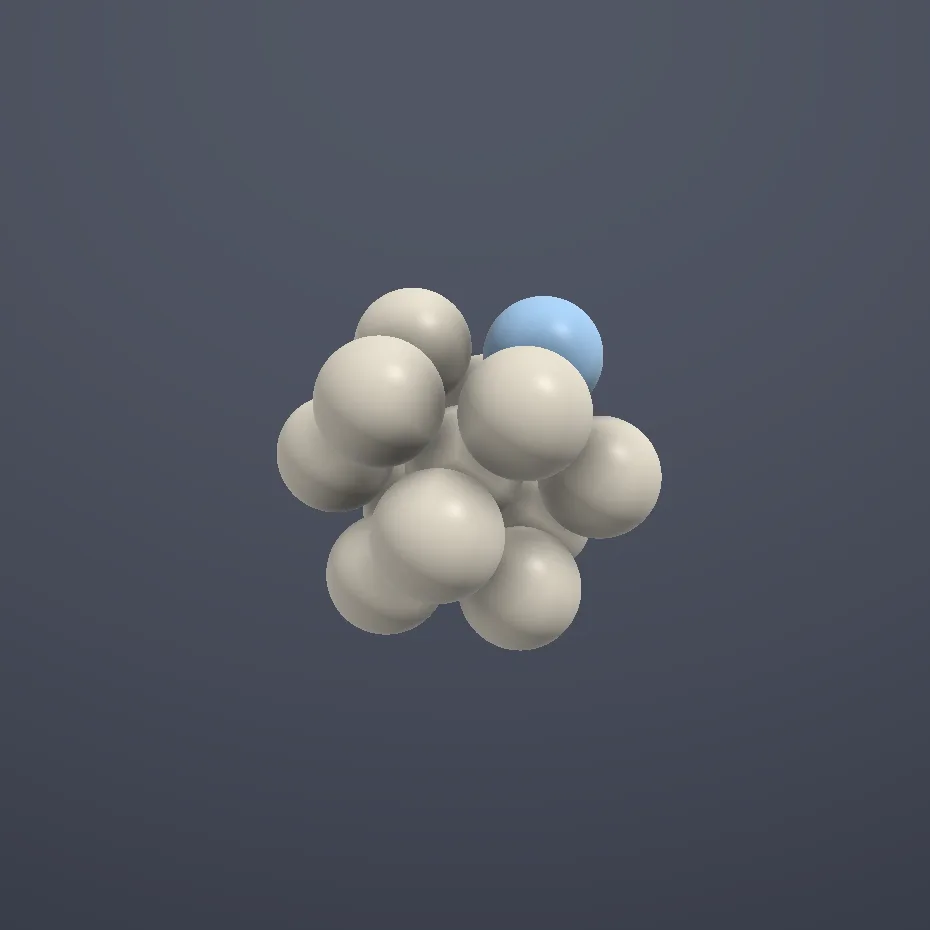 cross-section at w = 0.9
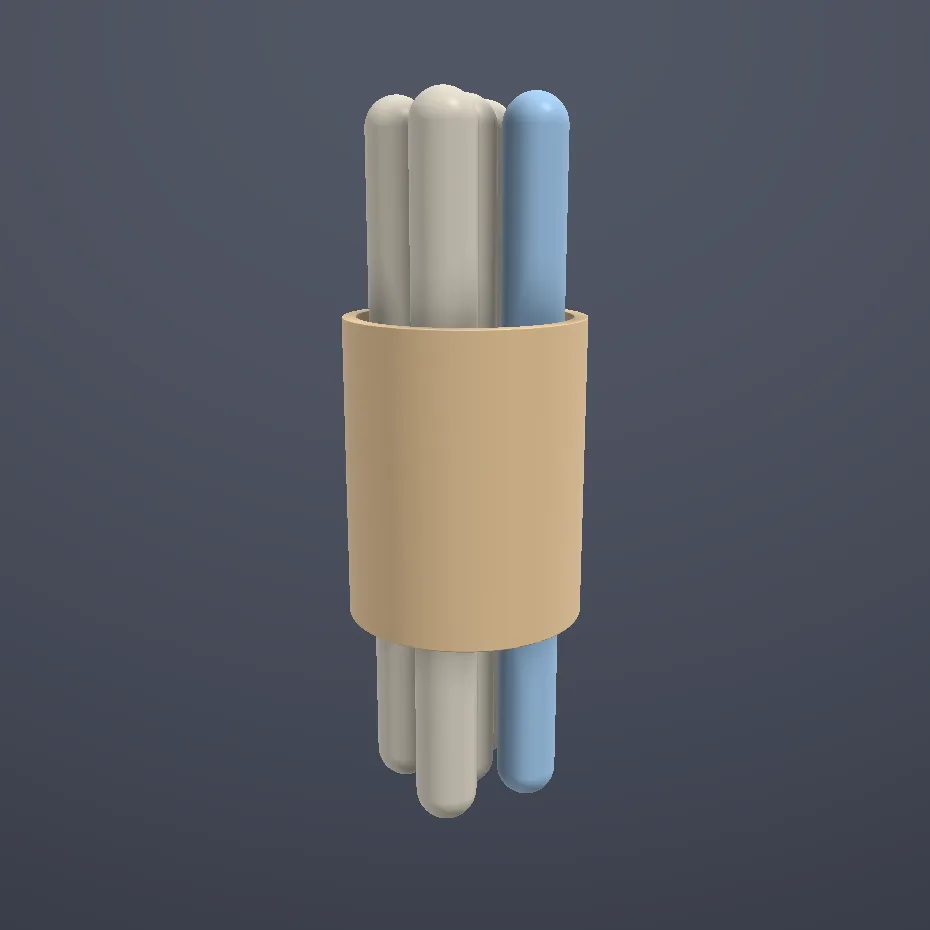 side view at z = 0 (w up)
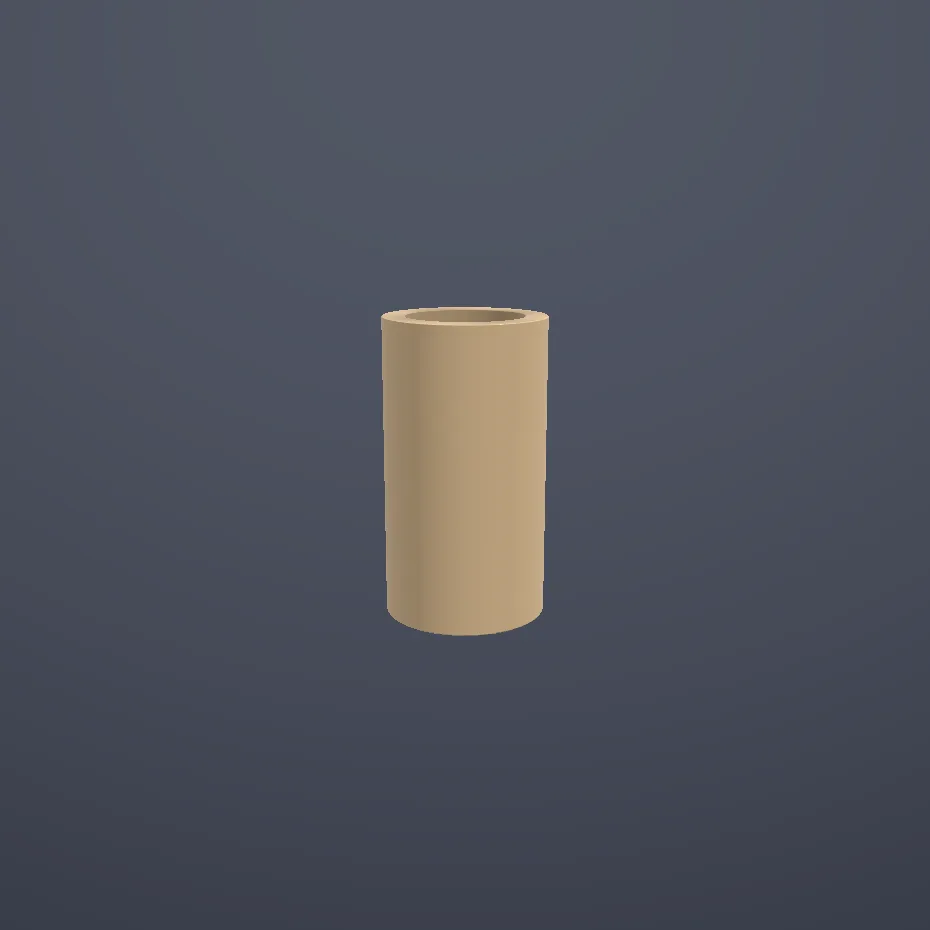 side view at z = 0.35
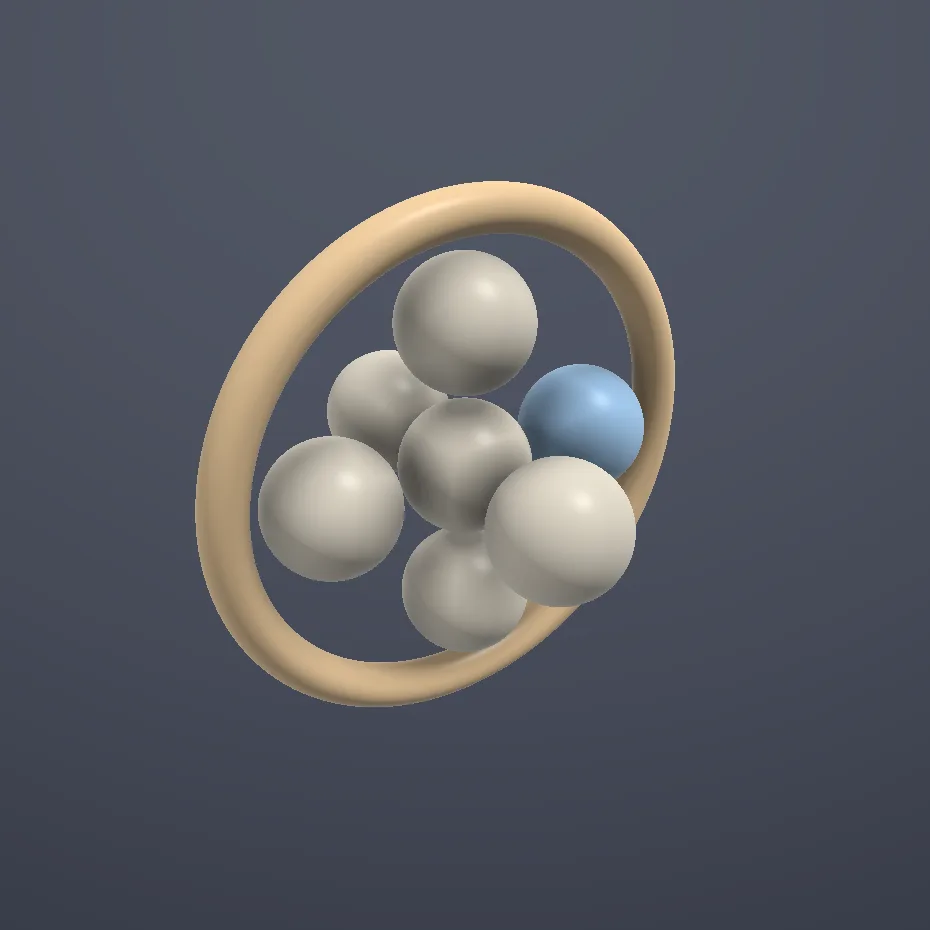 cross-section at w = 0
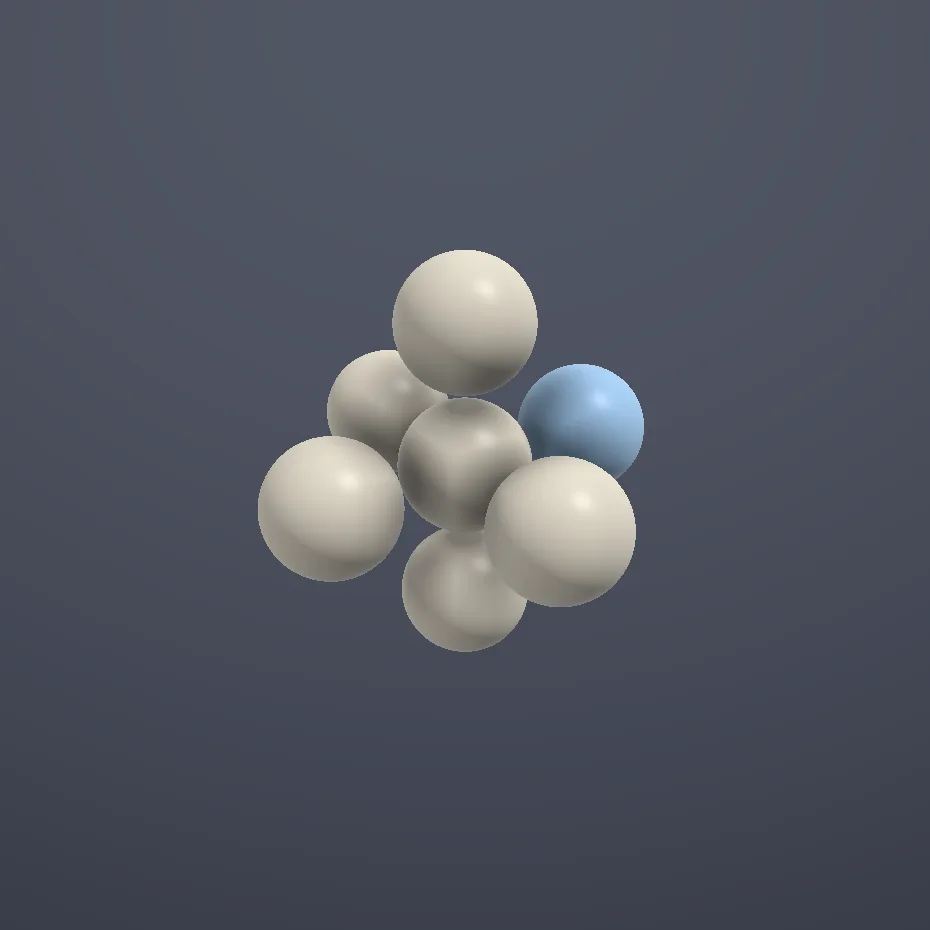 cross-section at w = 0.5
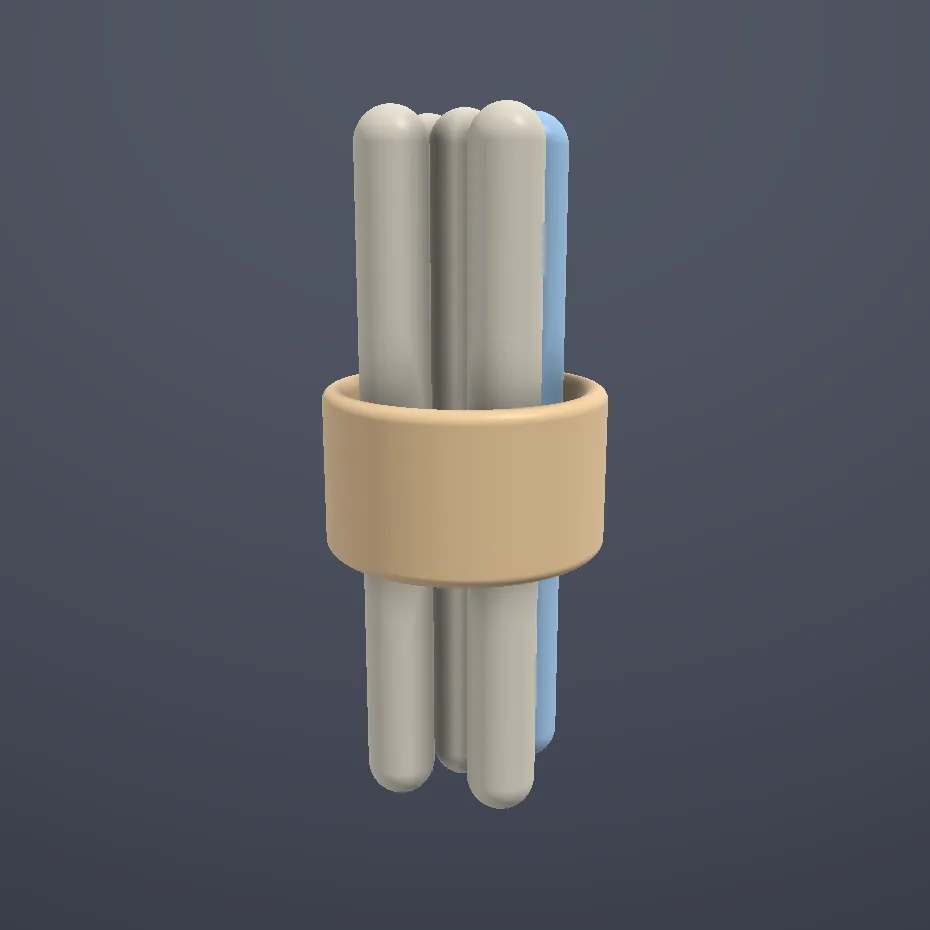 side view at z = 0 (w up)
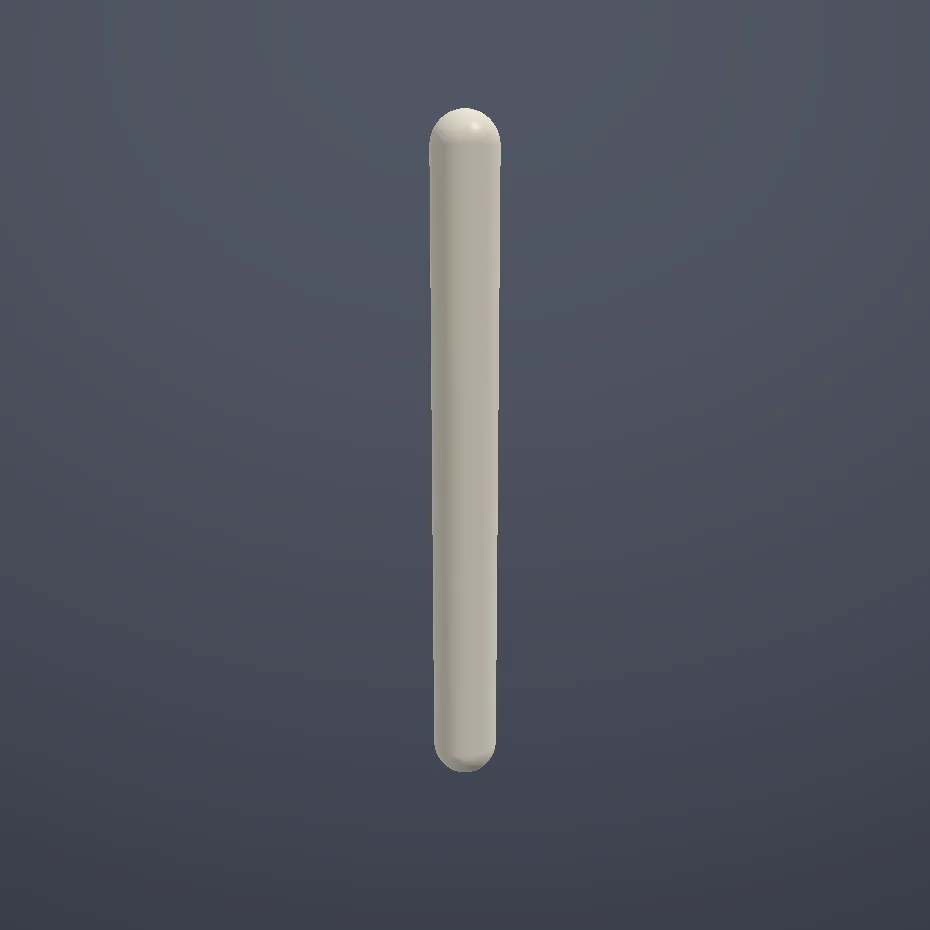 side view at z = 0.3
2. Methods
Three instruments, each with its own test file. Every number below that comes from a computation is filled into this text from the data file by the build, and a test fails if the two part.
2.1 Geometric tests in the CAD⁴ kernel
CAD⁴ is a solid-modelling kernel for four dimensions, written for this work. A part is a tree of operations that compiles to a distance function. Two parts interfere if a sampled grid finds a point inside both (12 to 20 samples an axis over the overlap of their bounding boxes, with cells proved empty by the distance bound skipped). A sampled grid can miss a small intersection, so "no interference" is numerical evidence, not a certified clearance.
Two kinds of test are used, and the results say which. A sweep translates one part rigidly along a named path in steps of 0.08 to 0.2 and records whether it interferes at any step; the steps are not always finer than the thinnest part (wires of radius 0.06), which is a second reason a clean sweep is evidence and not proof. A push displaces one part once, by 0.3 (several times the gap to its neighbours), along an axis and records whether it then interferes. Sweeps were used for the bundles in a hoop, a ring and a hose, the plaits, the knot and the Borromean link; pushes for the tube yarn, the maypole and ribbons on a tube, along x, y and z only.
Either test can show that a way out exists. Neither can prove that none does: they try rigid translations along axes and a few named paths. Where we say a link or knot holds, that rests on a cited theorem; where there is no theorem we say only what was pushed and what it ran into. Constructions made by revolving a three-dimensional curve (the tube plait, the tube knot, the tube yarn) are the spun surface of that curve (E8).
2.2 Bead-chain simulation of twisted yarn
Fibres are chains of 33 beads on springs (stiffness 3000) with a repelling contact (stiffness 6000) between beads of different fibres nearer than two radii (radius 0.1; length 4). Seven fibres, six round one, are laid as helices of a given number of turns, the ends clamped, the yarn stretched 3%, every free bead displaced at random by 0.002, and the system relaxed by damped dynamics (step 0.006, damping 0.985 a step) for 30 000 steps. The same code runs with three coordinates or with four; the only difference is one more direction for a bead to move in.
Measured at rest: the elastic energy; the contact force on the core and on one outer fibre, per length; that fibre's tension. Variants: the core replaced by a rigid ribbon of a given half-width; and thirteen fibres (one and the twelve that fit round it) inside a wall, which stands for a hose: a stiff penalty force on any bead whose centre is beyond a given radius, not a hard bound. The clamped end beads sit at radius 0.212, inside the loosest wall used (0.215) and outside the tightest (0.19). The hosed runs are 40 000 steps; one set is annealed (six random kicks of falling size, each followed by a relaxation).
There is no friction and no bending stiffness. So this instrument answers a narrower question than "does a 4D yarn hold": it shows whether twist is held by geometry alone. Each case is one bundle size. Relaxation finds a rest state, not necessarily the lowest.
2.3 Tensile model
 (a) The model
 (b) One pull of four ropes: force at the jaw against stretch
A rope is 96 sections long. Each fibre's place is a track of unit links: one continuous filament, or short fibres 40 links long laid end to end from a random phase. Links share one stiffness and each has its own strength, Weibull with modulus 5 (A2). Neighbouring tracks are joined at each section by a frictional interface, elastic (stiffness a quarter of a link's) until its shear reaches 0.3 times the press between them, then slipping at that force. Both ends are in jaws. This is the chain-of-bundles picture with frictional load transfer (A1–A7).
The rope is stretched in 110 steps to 4.5% (7% in the braid and sensitivity runs). At each step the equilibrium is the minimum of a convex incremental energy: with the friction limits and the slips so far held fixed for the step, a stick-then-slip interface has a potential. It is found by Newton's method with a banded Cholesky solve and a line search. Then any link over its strength is removed, worst first, and the equilibrium is found again. A solve is accepted if its final Newton step is under 10⁻⁹ of the stretch, or if the line search can make no further progress and the forces balance to a millionth of a link's strength; otherwise the pull is reported and excluded. (The audit found that an earlier version reported a stalled line search as converged. The force imbalances it measured in those cases were negligible, and the flag is now explicit. In the audit's follow-up run all 1 540 pulls were accepted.) A review reimplemented the solve with a different minimiser and agreed with it to eleven figures on thirteen small ropes.
The loading is in finite steps, which reads a peak a little low: at 110 steps a single strand reads 2.6% below its value at 1760 steps, and the hose rope's ratio to it moves from 1.102 to 1.096. The last decimal of every strength here carries that much.
Each rope is pulled 200 times (60 or 40 in the sweeps, as each figure says) with different random strengths and phases. We report the mean, the spread and the 5th percentile. Strength is in strands: one continuous strand's mean at the same length and scatter is 1. Weight is in strands, counting every sheath, hose, jacket and the extra length of a strand laid at an angle.
What differs between ropes is who touches whom, and the press:
| rope | who touches whom | the press between neighbours |
|---|---|---|
| loose bundle | 13: one and the twelve round it (D4) | none |
| twisted yarn | 7: one and six | q × (their mean tension + a laying tension), q measured in 2.2 |
| yarn on a ribbon | six fibres, each touching only the ribbon | the same law, q measured with a ribbon core |
| hoops | 13 | constant: a third of the skin's force on a fibre |
| hose | 13, and a fourteenth track, the hose, touching the outer twelve and carrying load | fibre to fibre a third of the skin's force; hose to fibre all of it |
| braid of strands | 3, or a core and 6; a strand at θ has stiffness cos³θ, strength cosθ, weight 1/cosθ | tan²θ × tension (B5, C2) |
| cable | 13 elements with the level below's measured strength distribution, stiffness and weight | as hoops |
The skin's force on a fibre comes from treating a hose τ thick as a thin pressure vessel (D1) under a hoop stress that is a share of its strength. One convention runs through the second model below: every stress is a fraction of the mean strength of a fibre link, so the hoop stress, the hoop strength it is compared with and the press derived from it are in one unit, and the press is the vessel formula's times the taut-skin factor of section 2.4 (0.81). The first model, and every study made with it, uses the uncorrected vessel formula and the Weibull scale in place of the mean, which presses 27 to 39% harder than this, depending on the fibre scatter.
Two models of the hose. The first, uncoupled, model sets that share at a half, and gives the hose's own track a stiffness and a strength equal to its weight with a fibre's scatter; its hoop stress never enters its failure. The audit showed that is not a material. The second, used for the results on the hose, treats the skin as one material with flaws. Each section of it (one link long, all the way round) has an axial strength and, independently, a hoop strength, both Weibull with the fibre's modulus and both reduced by the weakest-link size effect of a piece that large. Where the skin bends over a fibre its hoop stress is 2.3 times the mean (section 2.4). A section whose hoop strength is below that splits lengthwise and stops pressing, there and nowhere else. A section that breaks along the rope keeps pressing: a crack round the skin cuts no hoop path. Its axial strength while stressed in hoop is unaffected (the largest principal stress governs: a brittle skin). Tighter presses harder and splits more, so the tightness is no longer chosen: with the thickness, it is picked on seeds 1 to 30 by the 5th percentile per weight and the result reported on seeds 31 to 90. Section 5 changes each of these assumptions in turn. Hoops are the same material as separate rings, which split the same way and carry nothing along the rope.
The model has free choices, and sections 4 and 5 vary each, one or two at a time and not over the whole space: the hose's stress and the friction coefficient (which enter only as a product, so they are one dial); the laying tension of a yarn or braid; the rope's length; the fibres' scatter; and how much load the hose is allowed to carry.
The bench does not know a tube from a thread. A track is an abstract strand, and each row stands for a construction only through who touches whom and the press. The hose rows stand for the hose of figure 1. The braid rows are braids of plain strands: section 3.3 shows that such braids can be made of tubes, and the axial and contact laws used for them are assumptions carried over from threads, not derived for tubes.
2.4 Sheath pressure: three estimates
(a) The vessel formula. (b) A net of springs on an icosphere of up to 10 242 nodes, shrunk onto twelve rigid balls in their packed places and relaxed with the nodes kept outside the balls; the force on each ball is read against the net's mean tension. The same method on a band round six discs must give exactly one tension per disc, and does. (c) The same force from the convex hull's area and mean curvature (Steiner's formula; D3) and the virial of a closed film. Separately, how that force is shared: thirteen balls with one-sided linear contacts and diameters drawn at random, 200 packings a setting (D5).
3. Results: twist, fastening and braiding
3.1 Twist
 (a) Seven free fibres: turns kept at rest against turns given
 (b) Thirteen fibres between a core and a wall: rest energy against whole turns given
Thread yarn. In three dimensions the turns stay and the fibres press on the core. In four every whole turn leaves through the spare direction, the pressure goes to zero and the energy returns to the untwisted value (4.7 against 4.7). A half turn stays in both worlds: it cannot be undone with the ends clamped. With no jiggle the 4D twist stands, so it is an equilibrium, and an unstable one. So, in the frictionless relaxation studied here, whole-turn winding and contact pressure disappear. Assigning that zero pressure to the staple-yarn row of the bench gives its zero strength: the zero is an input carried over, not a second experiment. A yarn with friction, bending stiffness or a particular preparation might hold an unstable twisted state against small disturbances; that needs a coupled experiment we have not done. What is established is the loss of the geometric trapping.
Ribbon core. A ribbon core holds the twist if the ribbon is wide enough that a fibre cannot slip round its edge: the threshold lies between half-widths of 0.1 and 0.2, one to two fibre radii.
Bundle between a core and a hose: in these runs one turn is kept and two are shed. Thirteen fibres inside a wall were given whole numbers of turns, 3 seeds each. With the wall where the fibres just touch, every even twist came to rest at the untwisted energy (19.3) and every odd twist at 45.4. With the wall loose, so that nothing is squeezed, the same: 8.8 for even and 33.9 to 34.5 for odd. With no wall at all the thirteen shed everything (8.8 whatever they are given).
A second test gives quarter turns, which put the top end back on the packing's own sites, and anneals. If twist is kept modulo two turns, the rest energy should repeat every two turns and be the same at t and 2 − t; free fibres' ends differ only modulo one turn. The lowest rest energies over 3 seeds, at 0, ¼, ½, ¾, 1, 1¼, 1½, 1¾ and 2 turns: 52, 53, 61, 64, 77, 64, 57, 53, 52; at 3 and 4 turns, 77 and 56. The free fibres repeat every single turn, 8.8 at each whole turn and 13.6 to 14.7 at each half. (This test used a wall tight enough to compress the bundle, where runs sometimes jam above the lowest state: whole turns there rest at 52 to 63 when even and 77 to 90 when odd. An earlier draft reported that overlap without the looser walls, and understated the result.)
Known mathematics gives the same count, under a reduction we have not established. Suppose the twelve outer fibres, confined to a shell between the core and the wall, can be treated in each cross-section as twelve points on a sphere. Then their paths along the rope are a braid on the sphere. In the braid group of the sphere the full twist has order two (H3). Equivalently, a framed curve in four dimensions has two framings, not a whole number of them, because the rotations of three-dimensional space have a single non-trivial loop (H1, H2, F6): the belt trick. In three dimensions the corresponding count is a whole number, and a clamped elastic rod there already has exactly these two classes once it is allowed to pass round its own ends (H4). We did not find the consequence for a twisted bundle in four dimensions stated anywhere.
Two things are being compared and they are not the same kind of thing. The theorem counts topological classes of an idealised configuration space. The simulation reports which rest energy a relaxation reached. The model's fibres have thickness and soft contacts, the wall is a penalty and not a bound, and the core moves, so that its configurations reduce to sphere braids is a separate argument, and it is open. A class is also not an energy minimum: the odd class could in principle hold several rest states, and a run can jam above the lowest. What supports the reading is the even/odd pattern at two wall radii and in the annealed quarter-turn runs, and the auditor's independent replays, in which an orientation fitted along the bundle had parity even, odd, even for the confined zero, one and two turns and even for every free case.
So a hose does not give a four-dimensional rope twist to grip with: at most one turn in its whole length. This was shown for one shell of twelve. Bundles of several layers are untested.
Tube fibres. Hollow tubes as the threads of four-dimensional textiles are proposed in G1 (whether that means the tube of our table or a hose we could not check). Revolve an ordinary twisted yarn and each fibre becomes a tube. In the kernel an outer tube pushed 0.3 along any of the four axes runs into the others. That is all that was tested: no mechanical simulation has tubes in it.
3.2 Fastening
Knots in thread. A thread cannot be knotted (F1, F2). The kernel illustrates the one move that matters: a strand at a crossing of a trefoil is lifted into the spare direction, carried through the place where the other strand is, and set down, and the sweep finds no interference; pushed through without the lift, the strands collide. One crossing changed makes a trefoil a plain loop. The model is cut into the moving strand and the rest, with gaps at the joins, so this is an illustration of a crossing change and not a verified isotopy of a closed knot.
Knots in tubes. A tube can be knotted. The same trefoil revolved is the spun torus of the knot, and its complement has the trefoil's group (E5, E8). In the kernel the strand that passed freely as a thread is stopped (the same cut model, so again an illustration; the theorem is the evidence).
A sphere round a post. In the kernel a bundle of rods inside a sphere-hoop cannot leave it sideways, where the same rods in a ring can (figure 1). So a sphere round a post is the four-dimensional counterpart of a ring on a rod: it cannot come off sideways and is free to slide along. That is the geometric core of a hitch. We did not model a line attached to it, or what stops it sliding. A ring through a sphere is a link of a chain (G1).
Borromean links. One explicit construction uses two round spheres and a ring (F3): in the kernel, with both spheres the ring is stopped along every axis, and with either sphere taken away it slides clear. Three rings cannot do it (F1). Systems made of spheres alone also exist (F4).
3.3 Braids and cloth
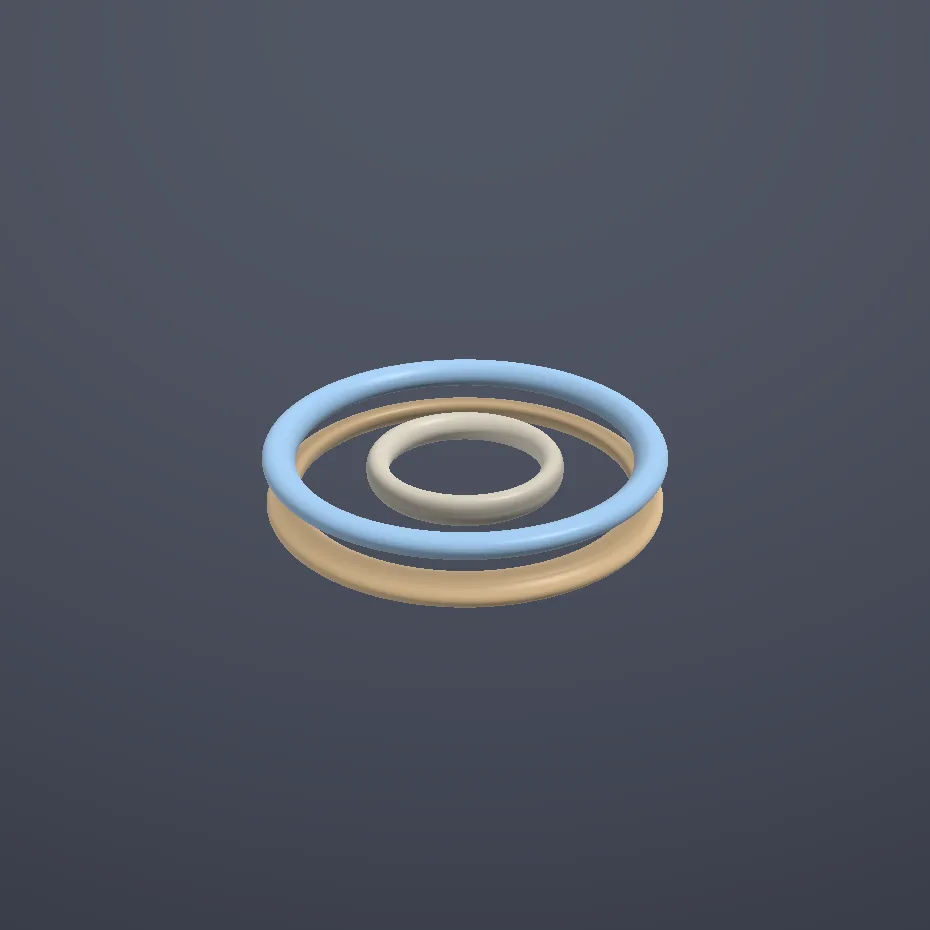 cross-section at w = 0
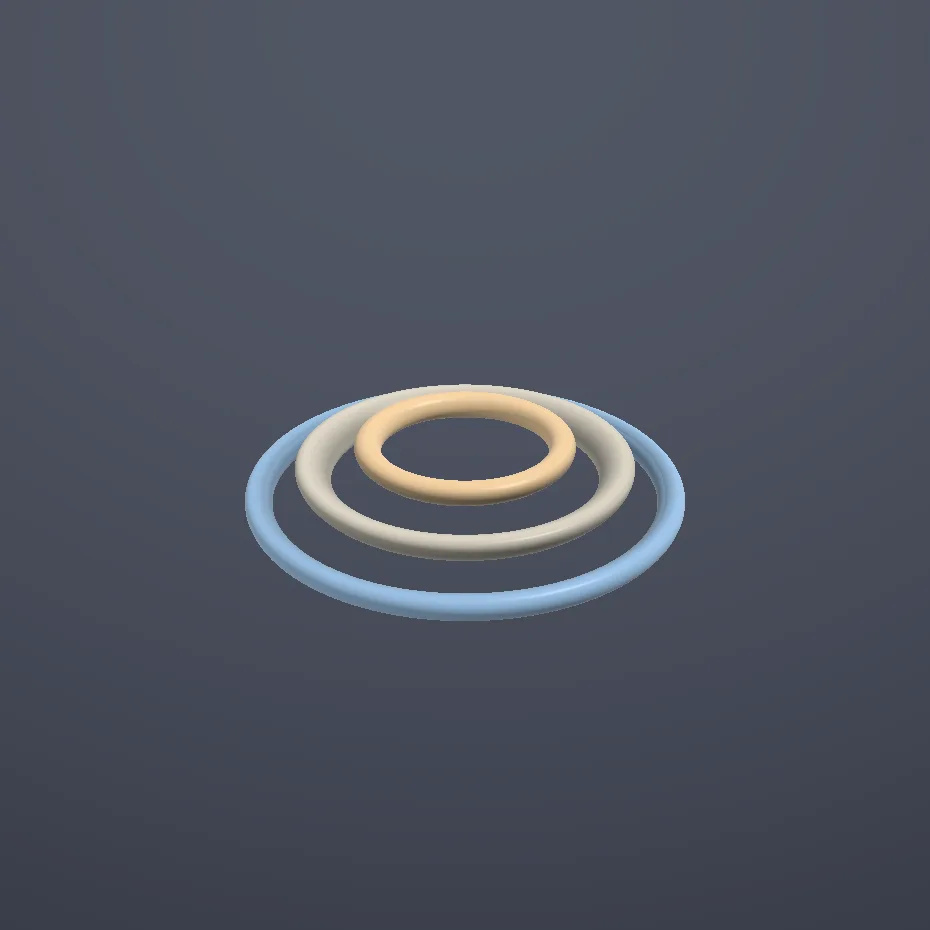 cross-section at w = 0.5
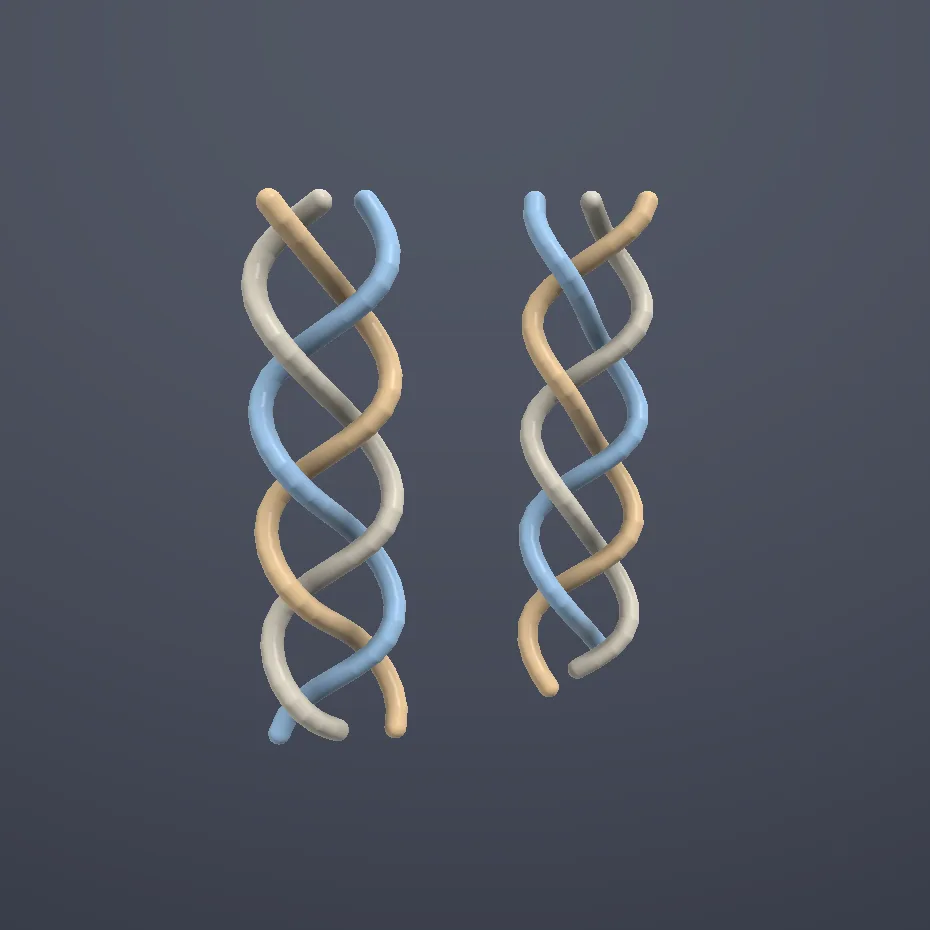 side view at z = 0 (w up)
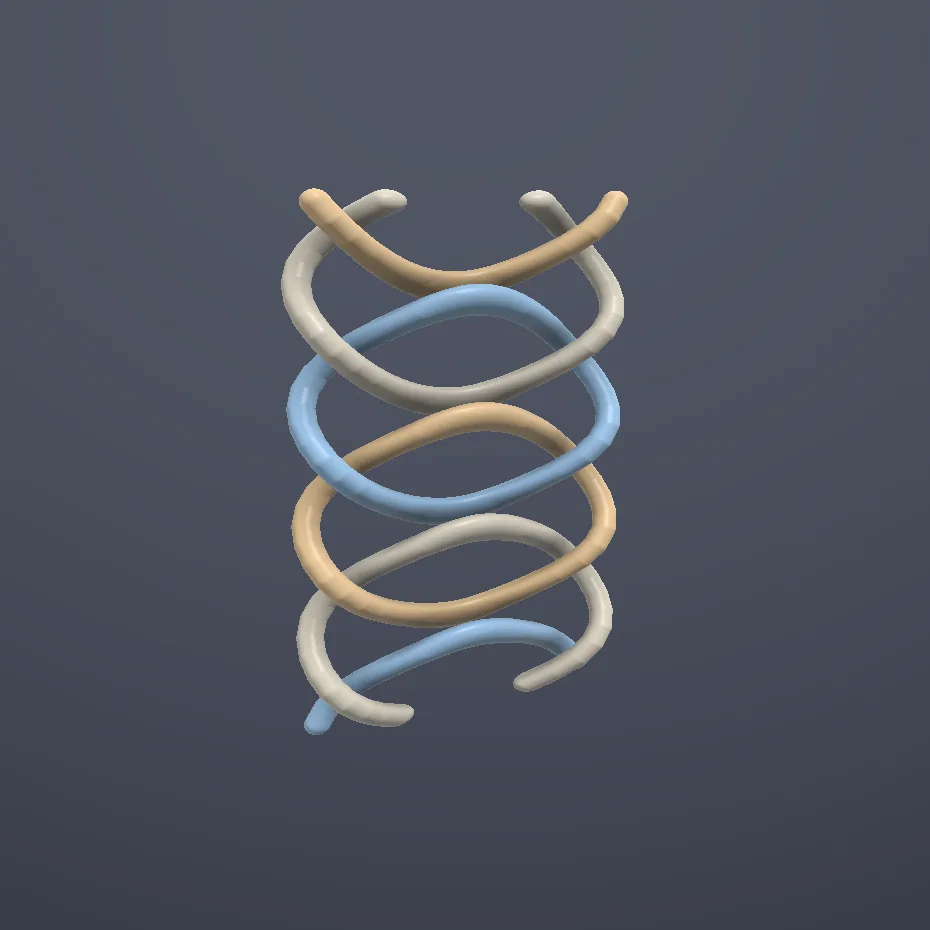 side view at z = 0.7
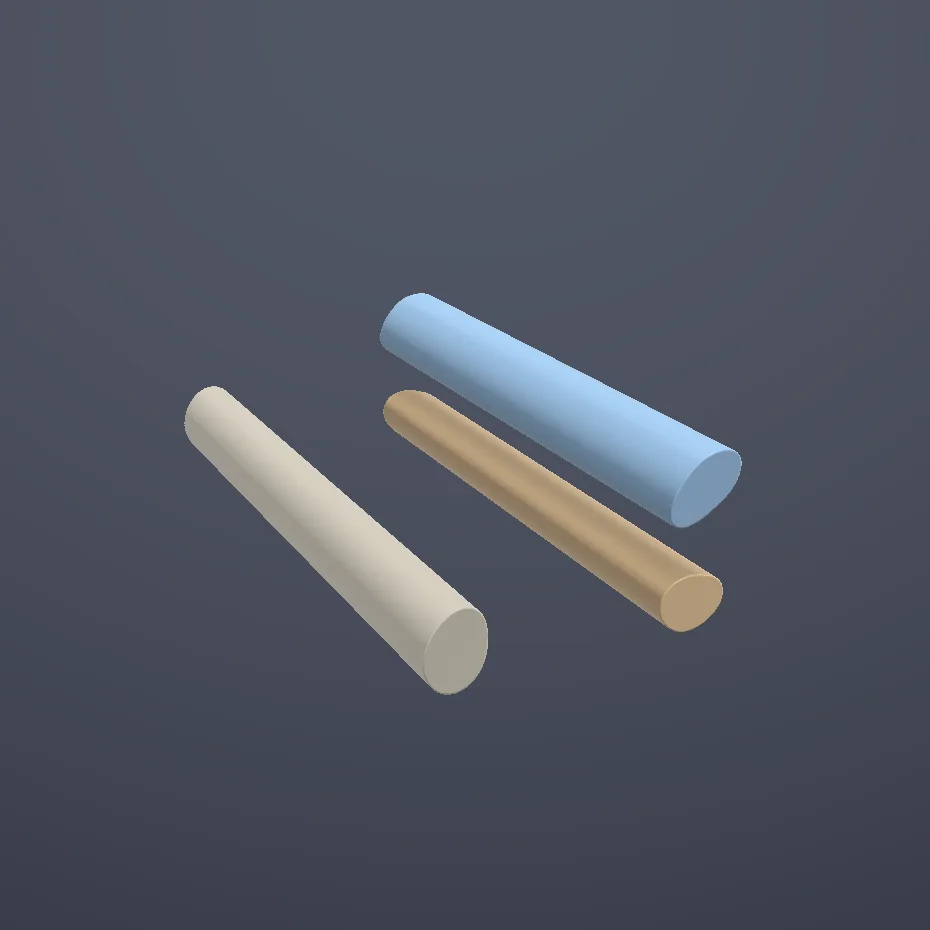 cross-section at w = 0
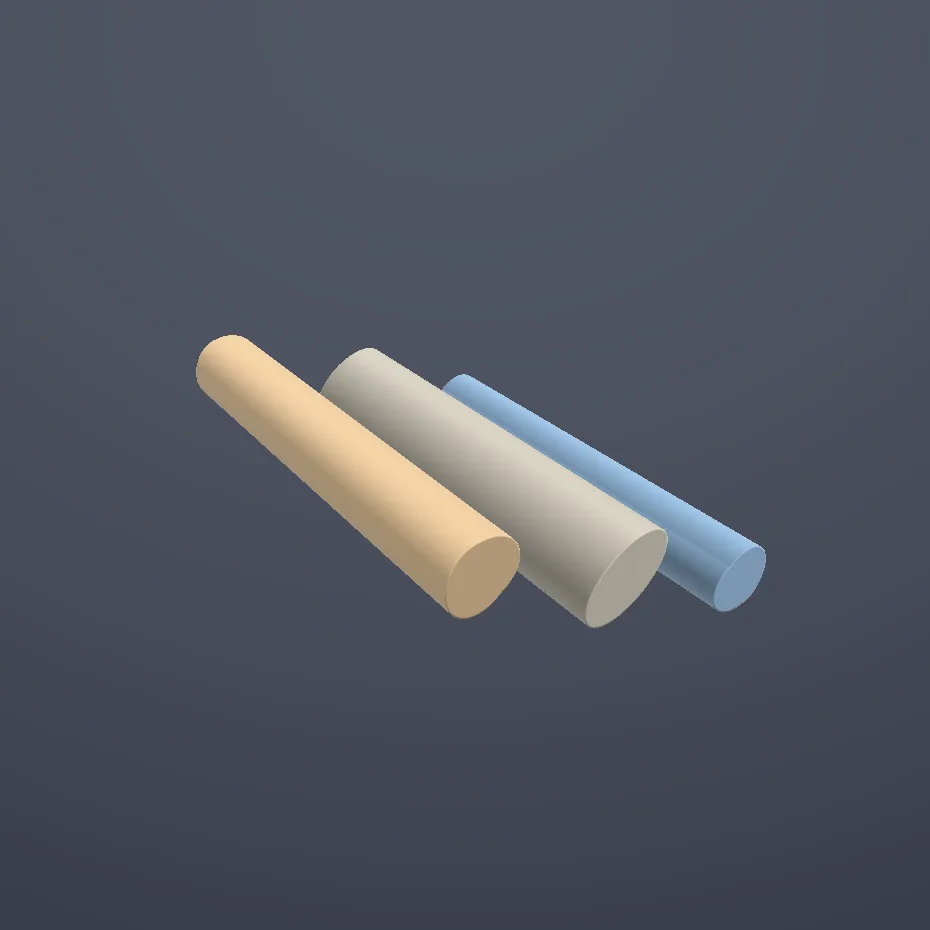 cross-section at w = 0.5
 side view at z = 0 (w up)
 side view at z = 0.3
Threads and ribbons. Threads do not braid, and neither do flat ribbons. A ribbon has edges, and in the kernel one ribbon of a plait is swept along its own width past the others and lifted away, touching nothing.
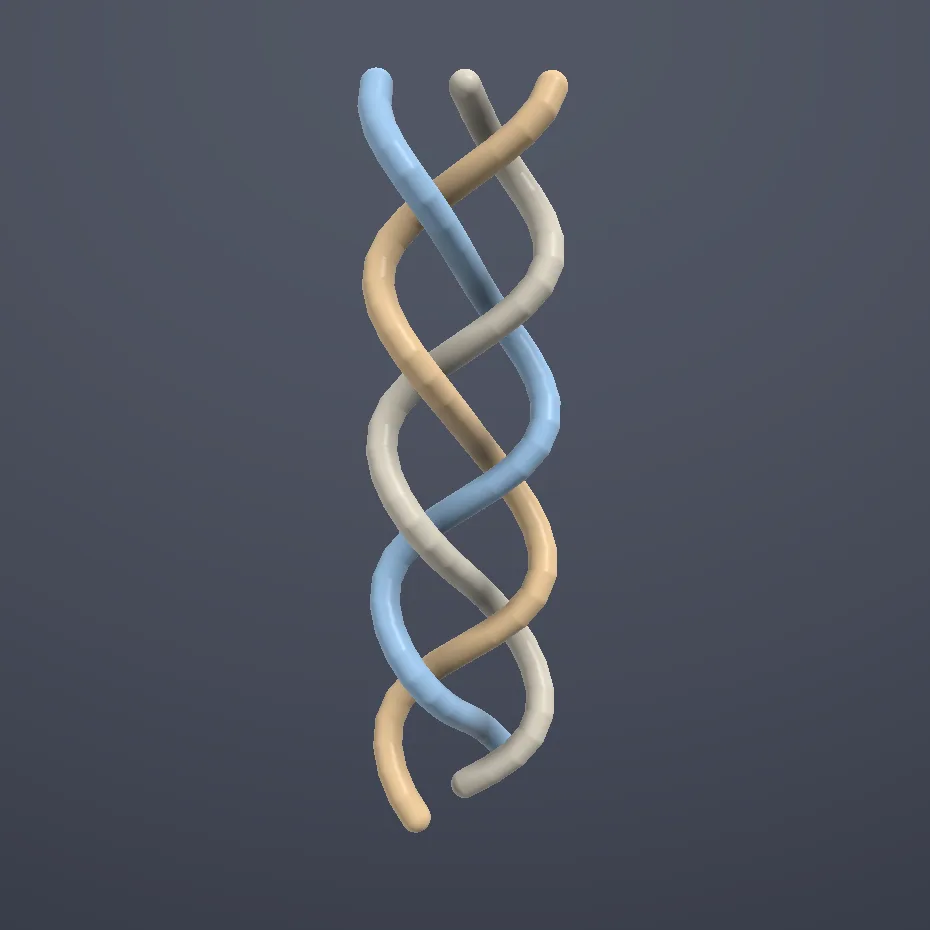
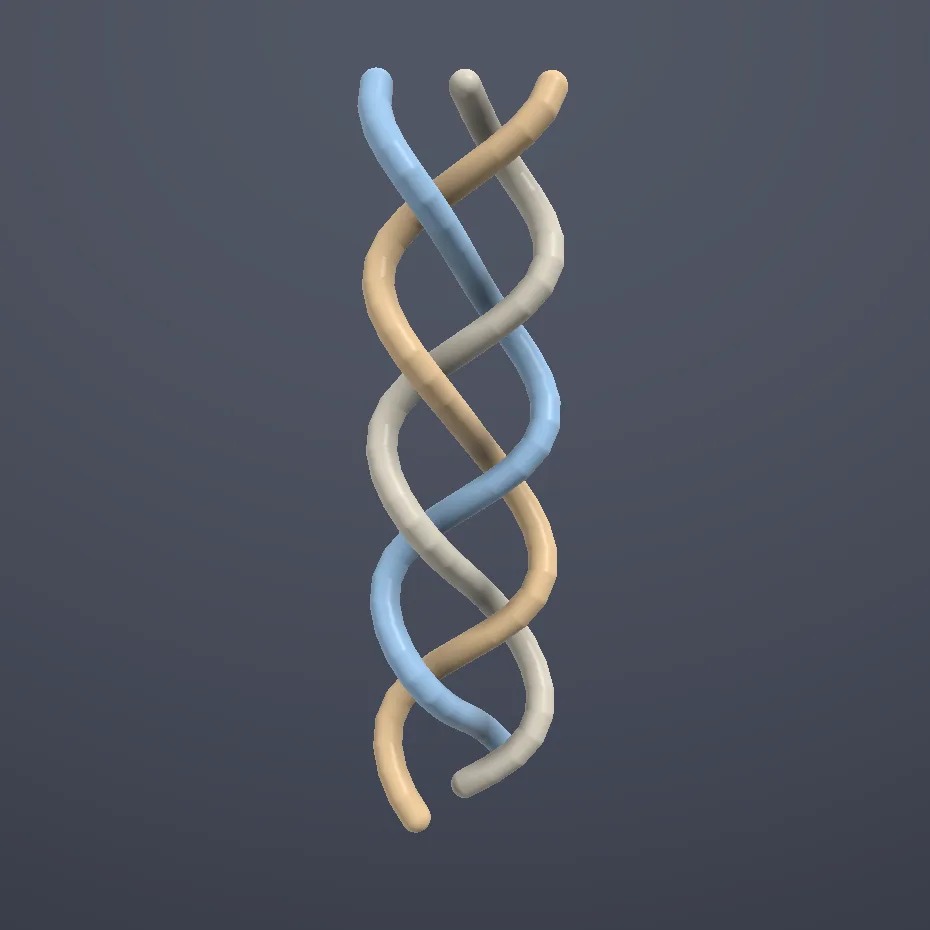
Tubes. Tubes braid. Draw any braid in a half-space and revolve it: every strand is a tube and every crossing is one tube passing through another. The mathematics is the loop braid group, into which the ordinary braid group embeds (E1, E6). In the kernel one tube of a three-tube plait, swept along any of the four axes, runs into the other two.
Braid on a core. Six tubes braided round a seventh (a maypole): each of the six, and the core, pushed 0.3 along x, y or z runs into the rest. By the same counting that lets a ring of rods fall out of a ring, a ring of tubes round a thread core should leave the core free along the ring's axis; that case was not built.
Ribbons on a tube. Six ribbons wound on a tube: each pushed 0.3 along x, y or z runs into the tube, and one slides round the tube past its neighbours' edges touching nothing. So the ribbons are held by the tube, as far as pushes show, and are not held by each other.
Cloth. Cloth is threads woven with ribbons, or sheets with sheets, which is published (G3, G6).
4. Results: strength per weight

Filaments in a hose, across fibre scatter and friction. Thirteen filaments, 96 sections, the hose as a material with flaws and its thickness and tightness optimised in each cell on one set of seeds and reported on another. Each fibre scatter has its own reference strand, which is 1.
| Weibull modulus (a strand's spread) | loose | hoops, μ 0.3 | hose, μ 0.15 | hose, μ 0.3 | hose, μ 0.6 | hose ÷ loose, μ 0.3 |
|---|---|---|---|---|---|---|
| 3 (38%) | 0.64 | 0.83 | 0.93 | 1.07 | 1.22 | 1.68 |
| 5 (23%) | 0.71 | 0.78 | 0.87 | 0.93 | 1.01 | 1.31 |
| 10 (12%) | 0.81 | 0.79 | 0.87 | 0.90 | 0.93 | 1.11 |
| 20 (6%) | 0.89 | 0.82 | 0.90 | 0.92 | 0.93 | 1.03 |
- The hose rope is worth more than the loose bundle in every cell, by a factor of 1.01 to 1.91. The factor is set by the fibre's scatter: a skin lets a broken filament carry load again a little way along, and that is worth a great deal when filaments have weak spots and almost nothing when they do not.
- Against a single strand it runs from 0.87 to 1.22, above 1 in 3 of the 12 cells: only for scattered fibre, and at modulus 5 only with high friction. A strand is a weakest-link chain, so a scattered one is weak and a rope looks good beside it. The comparison also moves with the rope's length, for the same reason (supplement B).
- Reliability. At modulus 5 and μ 0.3 the hose rope's 5th percentile is 0.85 per weight, against a strand's 0.56. What a rope buys before anything else is that it can be counted on.
- Hoops grip and carry nothing. They are below the loose bundle per weight in 5 of the 12 cells: with uniform fibre their weight costs more than their grip returns.
- How tight. The optimiser chooses a hoop stress of 0.3 of the skin's strength at modulus 5, where 24% of its sections have split. At the half we had assumed before, 97% would. The map's grid of tightness stops at 0.3, and the optimiser chose that top value in 9 of the 12 cells, so those cells are a lower bound on the best hose. The closure study of section 5 searches up to 0.5 and chose 0.3 at modulus 5 and 0.3 at modulus 10.
Bundle size, and twelve neighbours against six. A four-dimensional fibre has twelve neighbours in a bundle and ours has six, and a larger bundle has a smaller share of its fibres at the skin. We ran both worlds: clusters of 13 and 55 fibres in a hose, and hexagonal bundles of 7, 19, 37 and 61 in a load-bearing tube, the like-for-like rope in three dimensions. The same flawed-material skin, with a band's uniform tension in three dimensions in place of the stress peak; thickness and tightness tuned at each size on one set of seeds and reported on another; 48 sections, because the larger bundles are slow, so these figures are not comparable with the table above.
| world, fibres | loose | spread, loose | in a hose | spread, in a hose | hose ÷ loose |
|---|---|---|---|---|---|
| 4D, 13 | 0.70 | 13% | 0.83 | 7% | 1.18 |
| 4D, 55 | 0.68 | 6% | 0.76 | 4% | 1.12 |
| 3D, 7 | 0.72 | 16% | 0.80 | 12% | 1.11 |
| 3D, 19 | 0.70 | 10% | 0.78 | 7% | 1.12 |
| 3D, 37 | 0.68 | 7% | 0.77 | 4% | 1.12 |
| 3D, 61 | 0.68 | 6% | 0.75 | 4% | 1.10 |
- A bigger bundle is not stronger per weight, in either world. The mean falls slightly with size. What grows is consistency: the spread of the 55-fibre rope is 4% against 7% for thirteen.
- No clear advantage of twelve neighbours over six. The four-dimensional hose is worth 1.18 times its loose bundle at thirteen fibres and 1.12 at 55; the tube in three dimensions is worth 1.10 to 1.12 at every size. An earlier run, with the press set too hard, showed a wider gap. The two skins also differ (a sphere's skin pulls two ways and has a stress peak; a band has neither), and a loose bundle, having no contact, is the same in both, so the comparison does not isolate the neighbour count either way.
- The larger four-dimensional skin had to be made less tight (a hoop stress of 0.2 of strength, against 0.3): a bigger skin has more flaws, and at the same tightness more of it splits.
Other constructions, at the reference setting (modulus 5, μ 0.3), in the first, uncoupled model. These were not re-run with the new hose and are shown for their order, not their values:
| rope | per weight | note |
|---|---|---|
| twisted yarn of short threads, 4D | 0.00 | given no grip: section 3.1 |
| the same in 3D, hard twist | 0.64 | for comparison; no penalty taken for the fibres' angle |
| yarn on a ribbon, hard twist | 0.54 | the ribbon alone is 1.00; no angle penalty |
| thirteen filaments, loose | 0.70 | spread 11%, against a strand's 24% |
| filaments in hoops, uncoupled model | 0.86 | 0.78 with the new model |
| filaments in a hose, uncoupled model | 1.13 | 0.93 with the new model |
| short fibres in a hose, uncoupled model | 1.06 | short fibres in hoops: 0.70 |
| a hose that contracts more than its fibres | 1.15 to 1.25 | uncoupled; Poisson difference 0.2, and 1 |
| seven strands, loose | 0.73 | spread 15% |
| a core and six strands braided at 20° | 0.76 | spread 11% |
| plait of three strands | 0.77 | |
| six strands wound on a core, no grip on each other | 0.71 | |
| rope, cable, great cable (thirteen of each, hooped) | 0.84, 0.73, 0.63 | uncoupled hoops |
- Braids. A core and six braided strands read 0.76 against 0.73 for seven strands loose; the spread falls from 15% to 11%. The angle that grips is also the angle that costs.
- Cabling reads lower per weight at each level. This was done with uncoupled hoops, at one setting.
- A hose that tightens as it stretches gained in the uncoupled model. In a model where a tighter hose splits, that gain is not established.
5. Validation and sensitivity
The hose model's assumptions, one at a time. Each row re-optimises thickness and tightness and reports on held-out seeds; ± is the standard error of the baseline.
| the hose's skin | modulus 5 | modulus 10 |
|---|---|---|
| baseline: brittle, stress peak 2.3, a split stays where it starts | 0.93 ± 0.01 | 0.90 ± 0.01 |
| axial strength by distortion energy (von Mises, in four dimensions) | 0.95 | 0.93 |
| axial strength by a linear interaction with hoop stress | 0.89 | 0.85 |
| evenly stressed (no peak over the fibres) | 1.02 | 0.93 |
| a split runs the whole rope | 0.81 | 0.87 |
| no size effect on the skin's strength | 1.03 | 0.92 |
| hoops: the same skin, carrying nothing along the rope | 0.78 | 0.79 |
| the same filaments, loose | 0.71 | 0.81 |
The hose stays above the loose bundle under every version. Whether it reaches a strand depends on the version: the range at modulus 5 is 0.81 to 1.03. The two assumptions that matter most are how far a split runs, which nothing here determines (if it runs the whole rope the best hose is barely tight, 0.05, and loses most of its advantage), and how evenly the skin is stressed. The distortion-energy criterion is our own extension to four dimensions and gives a hose that is helped by its hoop tension; we show it as a bracket, not a result.
What is still uncoupled. A split is all or nothing at a section; partial loss of press, the stress round a split's ends, and damage that grows under load are not modelled. The press is a vessel formula scaled by the taut-skin factor below, which was measured for thirteen fibres and is assumed for the 55-fibre cluster.
Convergence and reproduction. A candidate thickness and tightness is eligible only if every one of its thirty tuning pulls converged: 14 of 366 candidates were excluded whole on that ground, and each candidate's count is kept in the data files. All 2 280 pulls behind the reported rows of the two tables above were then re-pulled; each reproduced its stored figure and converged (0 failures).
The uncoupled model's dials. In the first model, friction and hose stress enter only as a product. Halved and doubled, with the thickness re-tuned, the hose rope reads 1.06 and 1.22; with both halved and held-out seeds, 0.94 ± 0.01. Rope length moves it from 0.96 at 24 sections to 1.26 at 192, and the loose bundle hardly at all (0.69 to 0.72). The laying tension does not touch the hose; it moves yarn on a ribbon so much that that rope can be ordered and not quoted (supplement B5).
Sheath pressure. A taut skin lies on the outer fibres and runs straight between them. The net of springs and the hull calculation agree to three figures, and give 0.81 of the vessel formula's value. The same method gives the exact answer in three dimensions. The skin's tightest hundredth carries 2.3 times its mean tension, which is the stress peak the hose model uses.
Load sharing between contacts. An outer fibre shares the skin's force among five contacts, a third each when the fibres are equal. An earlier version of the bench applied the whole force at every contact; the repository records the correction. With fibre diameters drawn at random the total grip on an outer fibre barely moves and the grip on the middle fibre scatters widely.
Grip law. Against the bead yarn, tension times curvature is within 20% below 20° (worst ratio 0.81) and understates by a factor of 1.4 above, on four twists. The braids were run at the boundary.
The ideal isotropic material. From linear elasticity written in n dimensions; these are our own short derivations and no source is cited for them. A bar pulled along its length by a small strain ε shrinks by νε in each of the other n − 1 directions, and stability bounds Poisson's ratio at ν ≤ 1/(n − 1): a half in three dimensions, a third in four. Its cross-section changes by −(n − 1)νε, which depends on the material and not only on the dimension: at the same ν of 0.2 a four-dimensional bar loses 0.6ε where ours loses 0.4ε. Only at the bound, an incompressible material, is the loss the same in both (ε), and only for such a material, with the same hardening law, does the usual condition for peak load in a ductile strand give the same stretch. We make no claim about necking beyond that. Two geometric statements do hold generally: a sheath that grips by contracting more than its fibres has at most a third to work with where ours has a half, and a flaw population that scales with volume makes a thick fibre weaker faster (its volume per length goes as the cube of its radius, not the square). The bench's links are elastic and brittle, so none of this changes its numbers.
Not modelled. How far a split runs, and damage that grows; bending; fibre migration; a hose's bending stiffness; creep of a shrink fit; bundles larger than thirteen; any mechanical difference between a tube and a thread. The tube yarn, the tube knot and the sphere round a post are geometry and cited theorems; none has been through a mechanical rig.
6. Discussion
The lesson is not that four dimensions is hospitable to rope. It is that the textbook fact was the wrong size. "A knot unties" is a statement about one curve. A rope is a made thing with parts of several shapes, and only the parts that are curves lose their hold on one another. Give the bundle a skin and the model says it is a rope. Make the strand a tube and geometry says it can be braided and knotted.
The twist result is the one we would single out. In our world a clamped bundle keeps any number of turns; in these simulations a four-dimensional bundle confined in a shell kept one, and a bundle not confined kept none. The count is the one the topology of the cross-section gives, and the simulation was not told it.
The strength comparison is a model's, and its absolute numbers move with choices we could not fix. What it supports, within the region of fibre scatter and friction we mapped and under the hose model of section 2.3, is a mechanism (a skin lets a broken filament carry load again), a consequence of it (the gain is as large as the fibre is scattered) and an order (a hose above the loose bundle), not a figure. It does not support "a rope beats a strand" as a general statement, in four dimensions or, we suspect, in three.
Contribution and prior work. Not the topology: the dimension rule, chains, sheet weaving, tubes as textile threads, the loop braid group, the spun torus, the Borromean link and the two framings of a curve in four dimensions are published and cited. Ours, as far as two prior-art passes could tell: the controlled three-against-four twist experiment and its ribbon variant; the observation that a confined bundle keeps exactly one turn; the kernel constructions and tests; the comparison of ropes on one bench with its weight accounting and its sensitivity; the taut-skin correction to the vessel formula; and the reframing. One forum (G6) was read only through search-engine summaries.
Contributions, data and code
Computation, code, analysis and drafting: Claude (Anthropic), working in sessions directed by the PI. Independent audit: Astra, an auditor instance directed by the PI, which read the paper and code at a pinned commit, ran its own diagnostics and reported eight findings; and, before it, a second Claude instance given the repository and no account of how it was made. Both sets of findings changed sections 1 to 5 and are recorded in supplement F with what was done about each. Direction, judgement and the reframing in the title: minor mobius. No human has audited the work.
Everything is in one repository, minormobius/agent01, under kata/: the kernel and parts (cad4/), the bead yarn (twist/), the bench and its studies (pull/), and this paper with its figure scripts (papers/r1/). The text's numbers are tokens filled from papers/r1/values.mjs, which reads the data files; a test fails if the built paper and the data part. The instruments run in a browser at kata.mino.mobi/cad4, /twist and /pull.
References
In each reference's tag: how far the citation, and then the claim relied on, was checked. The full list, with what each source is used for, is supplement C.
Supplement
- A. Rope drawings. Twelve ropes, four panels each, every panel live on a click: figures.html.
- B. Methods and results by chart. Each chart with its method and result: results.html.
- C. References with verification status: REFERENCES.md. D. Prior art: PRIOR-ART.md. E. The design space and the corrections made along the way: CONFIGURATIONS.md. F. The review and what was done about it: REVIEW.md.
Open items
- No human audit.
- The hose is now a material that can split, with its tightness optimised (sections 2.3, 4, 5), and the map covers fibre scatter and friction, and two bundle sizes. Still open in it: how far a split runs; damage that grows under load; rope length; bundles beyond 55 fibres, which the solver here cannot reach; a control that separates neighbour count from the skin's geometry; and the other constructions (braids, cabling, the tightening hose), which were not re-run with it.
- A frictional, loaded test of twisted thread yarn in four dimensions has not been done (section 3.1).
- The kept turn was shown by rest energies for one shell of twelve fibres. Larger bundles, an orientation field, and a source for the sphere braid group's full twist read in the original, are owed.
- No mechanical rig has tubes in it, and the laws used for braided strands are carried over from threads.
- The uncoupled model's study files were baked before the solver reported a stalled line search explicitly, and its tuned figures were chosen and reported on the same seeds. The new model's reported rows are re-pulled and checked.
- The twisted-yarn rows take no penalty for the fibres' angle, where the braid rows do.
- Several references are confirmed to exist and were not read; supplement C says which. The forum sources G6 and G7 are known only from search summaries.